Evaluation Resets Removed
Under Legacy, failing an evaluation meant paying an $80 reset fee to restart. Under 4.0, failure means buying a new evaluation. Old guides still tell readers to "just reset" — it's not an option anymore.
The 4.0 changes broke resets, altered drawdown mechanics, tightened inactivity rules, halted metals, and introduced tiered activation fees. Most content online still references the Legacy program. This is a field guide for the actual current version.
Three changes rolled out on March 1, 2026 that invalidate almost every guide written before then. If you've been reading Apex content and none of these came up, you've been reading Legacy.
Under Legacy, failing an evaluation meant paying an $80 reset fee to restart. Under 4.0, failure means buying a new evaluation. Old guides still tell readers to "just reset" — it's not an option anymore.
Legacy allowed one $150 profit day within every 150 calendar days. 4.0 requires two $50+ profit days within every rolling 30-day window. Traders who follow old advice come back to permanently closed accounts.
No longer a flat $99. Fees now range from $89 (25K Intraday) to $159 (150K EOD), with EOD always $20 more than Intraday at every size. The economics of which account to buy changed materially.
Those are the surface changes. The manual covers the full structural overhaul — drawdown mechanics across three platforms, the EOD vs. Intraday decision, PA scaling and contract limits, the 50% consistency rule, and ten specific ways funded accounts fail.
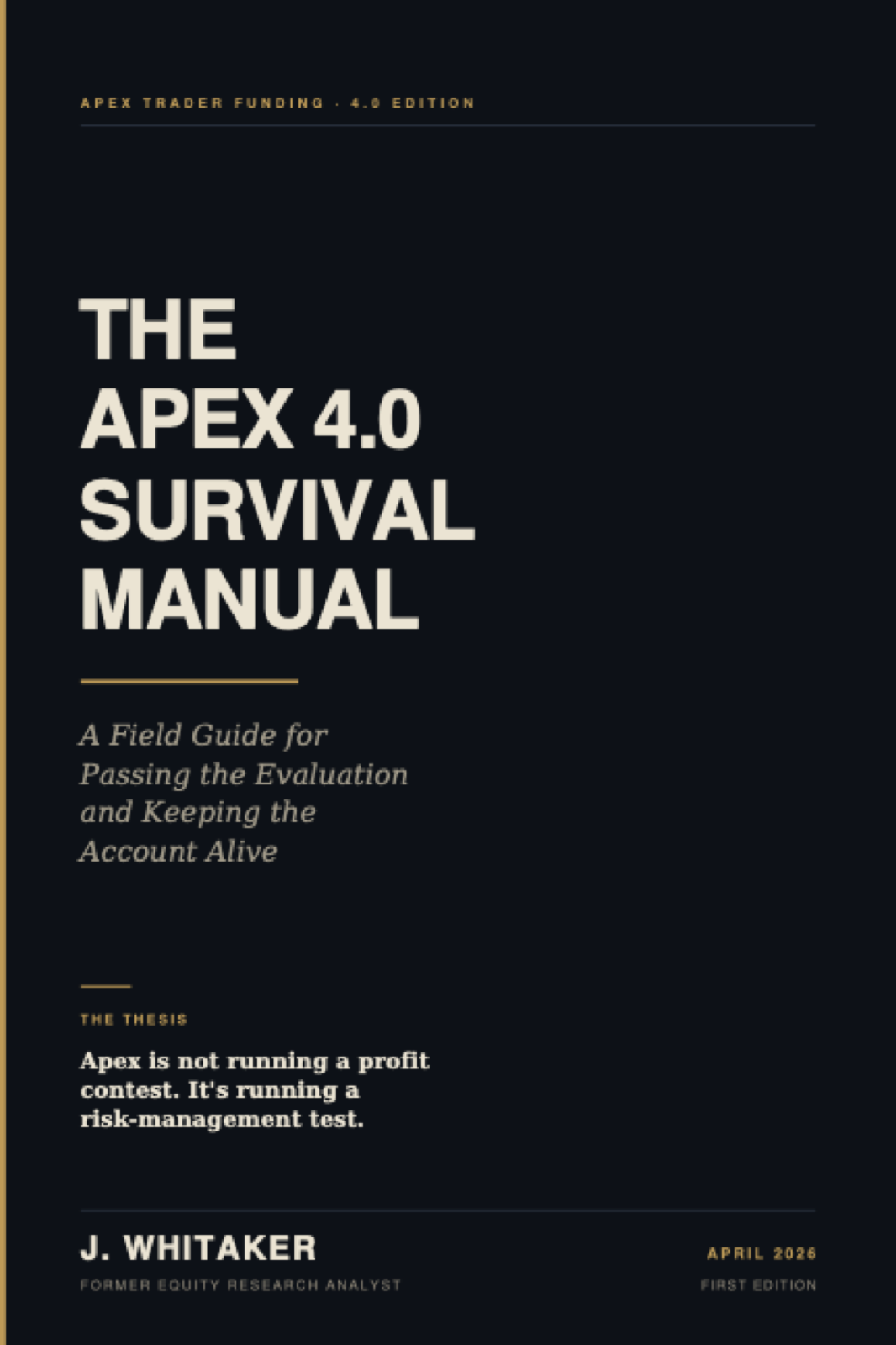
Apex is not running a profit contest.
It's running a risk-management test with a profit side effect.
Pass the risk test, the profits are almost automatic. Fail the risk test, the profits are irrelevant. Most evaluation failures trace back to traders who optimize for the target instead of the mechanic that stands between them and it.
Structured to be read cover-to-cover before your first evaluation, then referenced one section at a time as you progress through evaluation, activation, and your first payouts.
Why the evaluation exists and what it's actually testing. Reframes what Apex is selecting for, walks through the single most consequential purchase decision (EOD vs. Intraday), covers the expected-value math most guides skip, and catalogs what changed in 4.0.
Technical deep-dives on the four risk mechanics. How the EOD threshold actually updates. How the Intraday threshold updates differently, including platform-specific behavior on Rithmic, Tradovate, and WealthCharts. Daily Loss Limit as a feature, not a punishment.
How to actually trade inside the rules. Position sizing, the only math that matters on an Apex account. A daily routine built around pre-market checks, in-session rules, and post-close review. When to reset a losing evaluation, when to push through, and when to walk away.
Ten ways accounts fail, and the full payout path. Ten specific failure modes with diagnosis and prevention, from the revenge-sizing spiral to the inactivity rule that blindsides traders still operating under Legacy assumptions. The full payout path — pass to deposit.
A pre-trade checklist designed to be printed and taped to your monitor. A quick-reference card with every 4.0 rule, fee, DLL value, tier table, and payout threshold at a glance. A glossary of every term the manual uses. A verification statement. A changelog.
The manual assumes you can already read a chart, place an order, and manage a position. It does not teach you how to trade. Honest filtering keeps refund rates low and reviews accurate.
No. The manual is an independent educational publication, not endorsed, sponsored, or produced by Apex. It covers Apex's public rules and program parameters as of April 2026, sourced entirely from Apex's public help center at support.apextraderfunding.com. Every claim in the manual is verifiable against a public Apex source.
Buyers receive quarterly updated versions at no additional cost for the first year. Any rule change that invalidates content in the manual triggers a revision, delivered via email to the address on file. The changelog in the back of the manual documents every revision, so you always know what changed and when.
If your existing guide was written before March 1, 2026, it references the Legacy program. The differences are substantial — resets, inactivity rules, activation fees, consistency rules, and metals availability all changed. Quick test: does your existing guide explain EOD vs. Intraday drawdown in detail, with the platform differences between Rithmic, Tradovate, and WealthCharts? If not, it's Legacy-era.
Most prop firm content is general — "how to pass any evaluation." This manual is specifically about Apex 4.0. Every rule, fee, drawdown threshold, and payout parameter is verified against Apex's public documentation. The manual does not attempt to cover TopStep, FTMO, or other firms. If you're trading another firm, a different manual will serve you better.
Instant PDF download after payment. Delivered via Gumroad (the checkout platform), with a copy also sent to the email address on file. Works on any device that can display PDFs — computer, tablet, phone, or Kindle with PDF support. No account required beyond the Gumroad receipt.
EU buyers: Under Directive 2011/83/EU you have a 14-day right of withdrawal on digital purchases, unless you explicitly waive it at checkout. The checkout page will ask you to confirm this choice.
Non-EU buyers: 30-day no-questions refund. Email the address on your receipt and the full purchase price is returned within five business days.
Each purchase is licensed to a single reader. Unauthorized reproduction, redistribution, or resale is prohibited and pirated copies don't receive updates. If a friend is interested, please direct them to this page. Volume licensing for trading firms or prop shops is available on request.
For the price of about a quarter of one failed evaluation, you get the reference most funded traders wish they'd had before their first purchase.